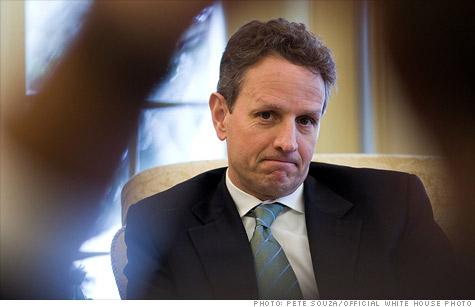
Treasury Secretary Tim Geither identified problems with Libor rate setting process when he was head of New York Fed in '08.
NEW YORK (CNNMoney) -- Treasury Secretary Tim Geithner suggested ways to prevent banks from manipulating the Libor interest rate in a memo to the Bank of England back in 2008, when he was president of the New York Federal Reserve, according to a copy of the memo published Friday.
The problems with the process 18 major banks use to set Libor -- a benchmark rate set in London that's used to determine trillions of dollars of loans worldwide -- have come into focus in the past two weeks. Barclays (BCS), the U.K.'s No. 2 bank, admitted that its employees regularly manipulated Libor between 2007 and 2009, and has agreed to pay $453 million to U.S. and U.K. regulators.
Barclays also admitted its employees conspired with other banks to manipulate the rate. Since then many of the world's major banks, including Deutsche Bank (DB), Royal Bank of Scotland (RBS), Credit Suisse (CS), Citigroup (C, Fortune 500), UBS (UBS) and JPMorgan Chase (JPM, Fortune 500) have disclosed that they are being investigated.
The memo, published in the New York Times, was disclosed ahead of scheduled document release from the New York Fed later Friday. A House subcommittee asked for the documents detailing New York Fed correspondence with Barclays about Libor.
Geithner, in the 2008 memo, made suggestions to reduce the incentive of banks to misreport the interest rate at which they borrowed from other banks, reducing the risk they would try to manipulate the market.
The memo, sent to Mervyn King, the governor of the Bank of England, does not specifically charge that banks were gaming the system in order to make money, as has since been revealed. But it said there needed to be improvements in the integrity and transparency of the rate-setting process.
The New York Fed, which oversees many of the major U.S. and foreign banks with operations on Wall Street, has already disclosed it asked Barclays about how it submitted its suggested Libor back in 2008. The New York Fed said it had received "occasional anecdotal reports from Barclays of problems with Libor."
A spokeswoman for the Treasury Department had no comment on Geithner's memo and referred all questions to the New York Fed, which also had no immediate comment.
Libor is used as a benchmark for an estimated $10 trillion in loans worldwide, including the interest paid by consumers on many variable-rate mortgages and credit cards in the United States.
It also is used as the basis for trading in an estimated $350 trillion in derivatives worldwide by major banks, so the manipulations may have cost pension funds and local governments that were trying to protect themselves against changes in interest rates by buying the derivatives.

No comments:
Post a Comment